


Indication
Compare Generative AI vs. Traditional Machine Learning. See how they handle data and create content. Stop guessing and start building with the best tech today.
Commentaires
Artificial Intelligence (AI) has revolutionised business worldwide. For professionals working in the competitive market, they need more than just understanding the use of these tools. They have to understand the underlying artificial intelligence tools that drive innovation.
There are two terms that are currently the talk of business town: machine learning (ML) and generative AI (GenAI). While they are both termed under the broader umbrella of Artificial Intelligence, they have distinct meanings and purposes.
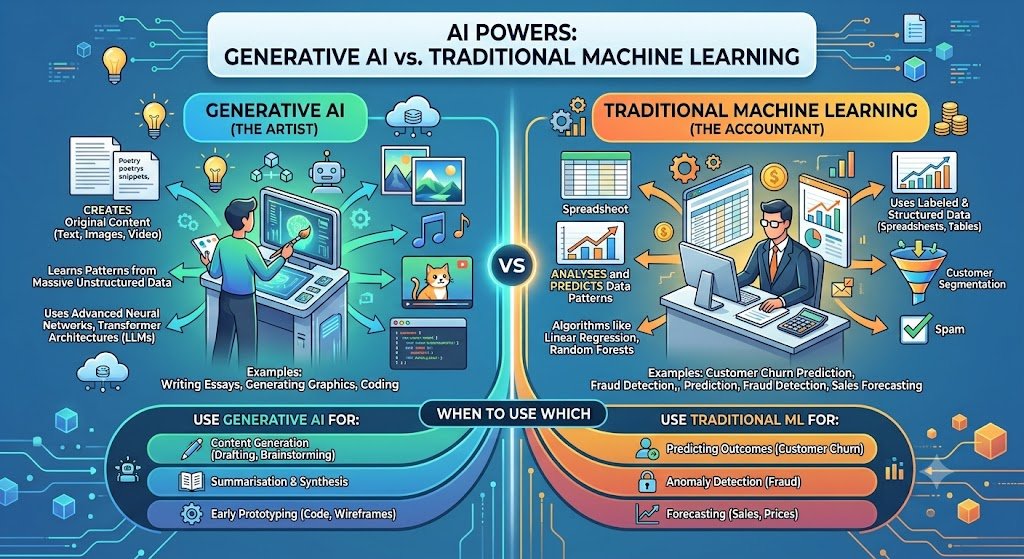
Think of generative AI as an artist who creates new, unique content every time, such as texts, images, videos, etc. Conversely, traditional machine learning tools are the accountants that analyse existing data to classify information, recognise patterns, or make predictions.
Let us break down the differences between these two powerhouses and look at how they impact our daily lives.
What is Generative AI?
Generative AI is a subset of Artificial Intelligence that creates original content, including text, images, videos, audio, and code, by learning patterns from existing data.
GenAI relies on advanced algorithms, such as Large Language Models (LLMs) and diffusion models. These systems are trained on massive datasets scraped from the internet. It analyses this data and learns statistical possibilities (e.g, predicting what word should come next in a sentence or what pixels belong in a specific image).
If you ask GenAI to write a poem about a rainy day in London. It will not copy-paste a poem from the existing dataset. It understands the pattern of how words relate to each other (what “rainy” feels textually). The model then constructs a freshly written poem syllable by syllable.
Furthermore, generative ability is precisely why AI language tools are now widely used for crafting academic papers or providing student support, such as best nursing essay help, by generating a structured outline, brainstorming ideas, or simplifying complex concepts.
What is Traditional Machine Learning (ML)?
Traditional Machine Learning (ML) is the use of algorithms that learn patterns from structured data to make predictions. It relies on humans to manually select data features.
This works efficiently on small datasets and also requires less computing power because it does not require a multi-layered neural network.
Differences Between Generative AI and Traditional Machine Learning
| Feature | Traditional Machine Learning | Generative AI |
| Primary goals | To analyse, predict, and classify data. | To synthesise and create novel data (text, images, code, etc). |
| Typical input | Highly labelled and structured data (e.g., spreadsheets). | Vast amounts of unstructured data scraped from the internet (e.g., books, articles) |
| Core mechanism | Statistical algorithms like linear regression or random forests. | Transformer architectures like Large Language Models (LLMs). |
| Use cases | Spam filtering, predicting house prices, and credit scores. | Writing essays, generating images, and writing software code. |
Choosing the Best Tool For Your Project
When to Use Traditional ML
Traditional Machine Learning uses algorithms like Random Forests or Logistic Regression to detect patterns in structured and labelled data. You must choose it over deep learning when there is limited data or you require highly interpretable decisions.
Traditional Machine Learning is best suited when your data fits neatly into rows and columns and your primary goal is to predict values and classify items.
The following are common use cases for traditional machine learning:
- Customer churn prediction: Analyse historical account data to identify which users are likely to cancel a subscription.
- Fraud detection: To spot anomalies in transaction patterns (like unusual locations or spending spikes) based on numerical inputs.
- Sales forecasting: It is best used to predict future revenue using historical sales metrics and market trends.
- Customer segmentation: Use traditional machine learning when you need to group an audience based on demographics or purchasing behaviour.
- Academic analytics: Medical educational platforms often use predictive ML models to evaluate student engagement metrics and identify whether the student needs additional help with nursing thesis projects based on their performance.
When to Use Generative AI
Using Generative AI is best to assist in ideation, drafting, and unstructured data analysis. It is best to use GenAI for qualitative tasks to optimise projects.
The following are the use cases for Generative AI:
- Content generation: GenAI is best used to draft copy, outline project charters, write personalised emails, or create marketing materials.
- Synthesis and summarisation: GenAI can process long meeting transcripts into actionable items.
- Brainstorming or ideation: GenAI can help overcome blocks by generating alternate perspectives, use cases, or risk management strategies.
- Early-stage prototyping: You can generate quick first-draft code or functional wireframes.
Conclusion
Traditional Machine Learning (ML) and Generative AI are two distinct subsets of Artificial Intelligence. Choosing between them is about matching the right tool to your specific goal.
If you need to analyse hard data and predict trends, traditional ML is your best bet. Conversely, if you need to draft content, images, or ideas, then Generative AI tools will support you.
Organisations which use both technologies smartly can unlock the potential and progress in the market.
FAQs
Is ChatGPT a generative AI?
Yes, ChatGPT is a prominent example of generative AI. It is developed by OpenAI and is powered by the Large Language Model (LLM) that generates entirely new content based on the user prompt.
What is the difference between AI and generative AI?
Artificial Intelligence (AI) is a broad term that builds systems capable of mimicking human intelligence to analyse data, make predictions, and automate decisions. Generative AI is a subset of AI trained to produce original content rather than just analysing existing information.
Which is best, traditional machine learning or generative AI?
Neither of them is universally best because both serve different purposes. Traditional machine learning is best for analysing data, detecting anomalies, and making predictions. Conversely, GenAI is best for creative tasks, content creation, and natural language interactions.
What are the traditional machine learning algorithms?
Traditional machine learning algorithms are interpretable methods that learn from structured data to make predictions and uncover patterns. They are broadly categorised into Supervised Learning (predicting known outcomes from labelled data) and Unsupervised Learning (discovering hidden structures in unlabelled data).
Mots Clés : Nurse Practitioner Conference